This is a review of two seemingly unrelated books, each written with obvious sensitivity to criticism from academic left-wing ideologues. Each book discusses a different aspect of our rapidly expanding understanding of how our innate biology interfaces with our life experiences to influence our behavior. One involves the neuroscience of ideology, and the other the nascent science of sociogenomics.
Amazingly, both authors felt the need to insert a “gasp” when finally at the point they assert genes have a role in our social behavior. This is a tip toe around the influence of ideologues in academia discussed in the previous essay on Nature vs Nurture.
One author, Leor Zmigrod, is a young Cambridge University professor who defines herself as a “political neuroscientist”. She has received numerous awards such as the United Kingdom’s Women of the Future Science Award. She is making waves worldwide with her new book “The Ideological Brain – the radical science of flexible thinking”.
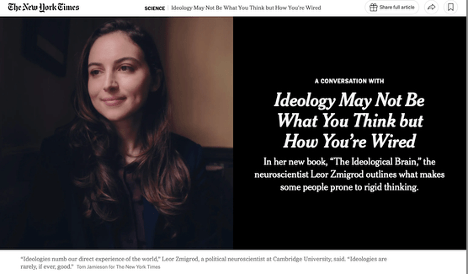
The New York Times published an interview recently in which she discusses the main points of the book. I encourage you to read it. I am attaching a copy in case the link limits your access.
She has done original research into the neurological mechanisms of inflexible thinking and rigid, often destructive, ideologies. In the book she has combined this with work done by others over the last 80 years to establish that rigid thinking has a strong, scientifically demonstrated genetic factor, and that environmental factors can either curb or exacerbate the behavior. She makes great effort to establish that genes create the predisposition toward embracing rigid beliefs, but for most people their social and informational environments either enhance or attenuate the tendency toward rigid thinking. Her research (using functional MRIs) has demonstrated the parts of the brain and the processes involved in ideology.
MAGA, fundamentalist religion, extreme left-wing dogma, or other rigid ideologies are examples of belief systems that resist rational facts. She does not offer specifics, but she does believe there is hope: (from her NYT interview) ” I think we all can shift in terms of our flexibility. It’s obviously harder for people who have genetic or biological vulnerabilities toward rigid thinking, but that doesn’t mean that it’s predetermined or impossible to change.” . (Strategies for change will be discussed in future essays. (spoiler alert – other studies show it involves peer pressure)).
The Surprise
Despite the fact that Ms. Zmigrod’s research has established the precise neurological differences in the brain structure and processes between flexible thinkers and rigid ideological thinkers, she dances around the fact very carefully, particularly in Chapter 12, “The Dogmatic Gene”. She couches every paragraph as a conversation between whispers. Here is just a snippet:
“WHISPER: Is it genetic?
WHISPER BACK: Is what genetic?
WHISPER AGAIN: Rigidity. Is my level of rigidity determined by my genes?
WHISPER SOFTLY: Yes, partially.
[Gasp.]
ANOTHER WHISPER: What does that mean?”
(Zmigrod, Leor. The Ideological Brain: The Radical Science of Flexible Thinking (p. 129). (Function). Kindle Edition.)
She knows her science has broken the academic taboo, hence the whisper voice and “gasp” when she finally says it.
Why is that my elephant in the room?
When a world-renowned researcher and author like Zmigrod is intimidated enough to dance that carefully, it leaves a writer without portfolio, like me, feeling the necessity to give you so much information all at once in order to engage you before you dismiss these essays as outside the mainstream .
In fact, they are in the mainstream of current science, but still not pervasive in popular culture. One example is the continued belief among right wing economists and legislators that human beings are innately rational and potentially disciplined, so poverty is evidence of moral weakness and inferior minds. As we have seen in the preceding paragraph, there is an undercurrent in liberal academia that we are all born kind and altruistic, and we are taught to hate. They seem to believe that understanding the real roots of hate will justify it rather than illuminate a path to curb it.Hence, I have continually looked for ways to avoid the nature vs nurture argument, for ways to avoid losing an imagined readership that I will forever hope to reach.
It is agony trying to write while looking over one’s shoulder, knowing that the anti-science fringe of the left has really controlled the public perception of human behavior. But Zmigrod’s book and another that came out just last month, “ The Social Genome”, (discussed below) have each dared to explain how their cutting edge work is explaining the complex interplay between our brain’s hard wired predispositions and the impact of our social and physical environment. I hope it is a sign that the tide is turning in favor of science over ideology.
The Elephant Continues
“The Social Genome: The New Science of Nature and Nurture”, by Dalton Conley, the Henry Putnam University Professor of Sociology at Princeton, is an introduction to Sociogenomics, the study of how genes and our environment interact to generate behaviors.

An admittedly liberal sociologist, Conley’s lifelong quest has been to gain an understanding of why some people thrive and others don’t. In his words:
“In short, with a better understanding of how nature and nurture operate as one, we can make sure more people fall into the thriving category.”
(Conley, Dalton. The Social Genome: The New Science of Nature and Nurture (p. 44). Kindle Edition.)
Incredibly, he also inserts a “Gasp” when suggesting there is a biological factor in addition to cultural/social factors – just as Dr Zmigrod did in her book :
“Parents who worked hard, who did well on tests, who were able to delay gratification, were conventionally attractive, or who had whatever else it took in our society to earn a lot of money also tended to be parents who passed on these adaptive traits to their offspring—culturally or even (gasp) biologically.”
(Conley, Dalton. The Social Genome: The New Science of Nature and Nurture (p. 52). Kindle Edition.)
I point that out to emphasize the trepidation that scientists have in the face of academic anti-science vitriol. It is likely that you and most of the public are unaware of how the strides science has made in explaining our behavior have been so muted. We shall see in the next essay that the reasons started out noble but have now become an unjustified rigid, extreme ideology.
Conley’s book explains the interaction between our genetic behavioral predispositions and the social environment we are born, raised, and live in is very complex. He concludes that understanding those factors will allow us to gain some level of control over those behaviors.
As promised, in the next essay we will delve into some detail why the academic left has had good reason to oppose bad science – divisive theories that pervert and misinterpret good science. Unfortunately, in their zeal, they have mindlessly disparaged the good science and tried to destroy the scientists. In some cases, they have even acknowledged that an agenda is more important than the truth.
Subsequent essays will show that gene studies, neuroscience, and behavioral science have established beyond any doubt that homo sapiens is not innately logical but can learn to be with effort, that we don’t learn to hate “others” but we can be taught not to hate those who aren’t perceived as part of our tribe(s), that we are innately aggressive but can learn to control that aggression. Evolution is not a steady march to some imaginary top. It is a messy process, and we are a particularly flawed product of that process. Only by understanding our flaws will it be possible to minimize them and possibly survive as a species.
You will learn that much of the common perception of who we are is not correct, and facts that conflict with our beliefs create discomfort (behaviorists call it cognitive dissonance) and we try to avoid them.
I hope you will overcome that tendency to avoid new facts that may conflict with your established beliefs (behaviorists call it confirmation bias) and find those facts give you a new way of viewing every aspect of human behavior.
We face an uncertain future as a species. By understanding our strengths and maximizing them, and understanding and addressing our weaknesses, we can stride into that future with hope.
Under Construction – subject to edits and rewrites before 3-1-26
 Human Behavior: an evolutionary perspective